On-Chain Data Suggest Bitcoin Has Not Hit the Full Bear Market Floor
Bitcoin is steadily approaching a price range historically associated with long-term buying opportunities.
However, current on-chain data suggests the market has yet to reach the conditions typically seen at previous cycle bottoms.
According to CryptoQuant data, Bitcoin’s spot price remains significantly above its realized price, a key indicator that most holders are still in profit. This marks an important distinction from past accumulation phases, where widespread losses were more evident.
Key Points
- Bitcoin trades at $68,774, roughly 21% above its realized price, meaning most holders remain in profit.
- A full market bottom historically coincides with spot prices falling below the realized price, which is not currently observed.
- Rapid compression: Bitcoin’s premium over realized price dropped from 120% in late 2024 to 21% today, signaling shifting market dynamics.
- Institutional sentiment shows mixed signals: Coinbase Premium Index negative, yet ETF inflows surpassed $1 billion in March.
- Analysts caution that Bitcoin has not yet entered a confirmed accumulation zone, despite recent stability around $65,000–$70,000.
Spot vs. Realized Price: A Critical Gap
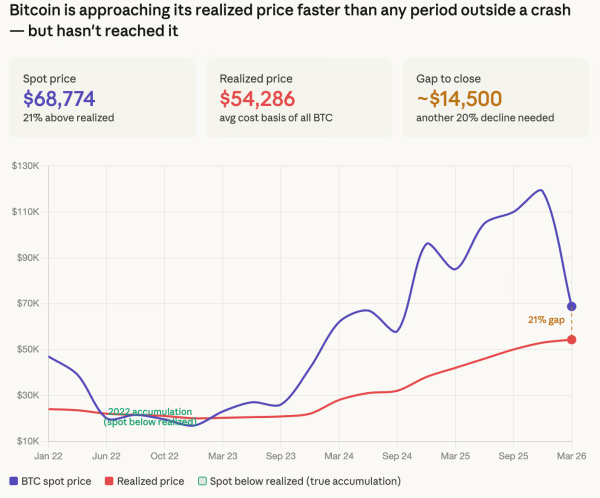
Bitcoin is currently trading at $68,774, while its realized price sits at $54,286. This creates a gap of roughly $14,500, or about 21%.
The realized price represents the average acquisition cost of all coins, based on the price at which they last moved. This metric is widely used to identify potential market bottoms.
Historically, when the spot price falls below the realized price, it signals that the broader market has entered a loss-making phase, often a precursor to strong accumulation.
 Bitcoin Spot vs Realized Price Gap
Historical Cycles Suggest Deeper Pain Before Bottoms
Looking back at previous cycles provides useful context. During the 2022 bear market, Bitcoin traded below its realized price for several months, reflecting sustained selling pressure.
Between June and October 2022, the market remained under this threshold. At its lowest point, Bitcoin dropped about 15% below the realized price, aligning closely with the cycle bottom near $15,500.
A similar dynamic played out during the early 2020 COVID-driven crash. In both instances, widespread investor losses created ideal conditions for accumulation, as market participants faced significant pressure.
In contrast, today’s market shows far less stress. With Bitcoin still trading roughly 21% above its realized price, the average investor remains in profit. This suggests that full capitulation, a hallmark of previous bottoms, has not yet occurred.
For Bitcoin to revisit its realized price, it would need to decline to around $54,000, implying a further drop of approximately 20%.
Rapid Compression Signals Changing Market Dynamics
Despite the absence of full capitulation, the gap between spot and realized prices has narrowed significantly.
In late 2024, Bitcoin traded above $119,000, with a premium of nearly 120% over its realized price. That premium has since compressed to just 21% over roughly 15 months, a sharp adjustment reflecting changing market dynamics.
Notably, such rapid compression is typically associated with major downturns. However, in this case, it has occurred without a full-scale market collapse, making the trend particularly noteworthy.
Is This Truly an Accumulation Zone?
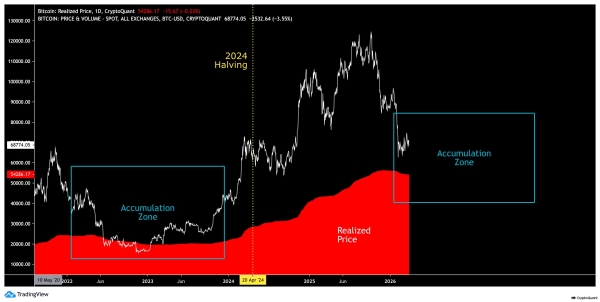
This evolving landscape has sparked debate among analysts. CryptoQuant analyst Oinonen recently suggested that Bitcoin has entered an “accumulation zone,” drawing comparisons to the 2022 bottom.
However, a closer look at the data raises questions about this view. In previous cycles, true accumulation zones formed only when prices fell to or below the realized price.
Since Bitcoin remains well above that level, some analysts argue that labeling the current phase as a confirmed accumulation zone may be premature.
Mixed Signals Across Market Indicators
Beyond price metrics, other indicators paint a mixed picture.
For context, the Coinbase Premium Index has recently turned negative, signaling weaker institutional demand from U.S.-based investors. This suggests a decline in buying pressure from a key market segment.
At the same time, there are signs of resilience. Bitcoin has held within the $65,000 to $70,000 range for roughly five weeks, maintaining stability despite geopolitical tensions, including the US-Iran conflict.
Additionally, ETF inflows surpassed $1 billion in March, indicating that investor interest remains intact, even amid uncertainty.
Closer to Opportunity, But Not There Yet
Taken together, the data present a nuanced outlook. Bitcoin is clearly moving closer to levels historically linked with strong buying opportunities, but key confirmation signals are still missing.
Most notably, the market has not yet experienced widespread losses among holders, a condition that has consistently marked definitive bottoms in previous cycles.
Until that level of pressure emerges, on-chain data suggests Bitcoin may still have further to go before a true market bottom is established.