Is Bitcoin ownership shifting? Why retail is selling as institutions buy

The crypto market was no longer just pricing the possibility of no interest rate cuts but rather the increasing likelihood of interest rate hikes in 2026, reported AMBCrypto. As a risk asset, this means the Bitcoin [$BTC] outlook would be more bearish if rate hikes were implemented.
The debasement narrative of fiat caused by rising inflation has helped drive gold to all-time highs, and it could help drive capital inflows to Bitcoin.
While the long-term outlook for Bitcoin, over many years, remains positive, some short-term developments and metrics can help put the current price trends into perspective.
Bitcoin regains institutional conviction while retail belief remains shallow
In a post on CryptoQuant Insights, analyst Moreno pointed out that institutional capital flow into Bitcoin outpaced the flow into Ethereum [$ETH]. Since the February crash, Bitcoin fund holdings have increased from 1.278 million $BTC to 1.370 million $BTC, a 7.2% increase.
Meanwhile, Ethereum fund holdings have dropped 2.14%, from 5.93 million $ETH to 5.80 million $ETH, a reduction of 127k $ETH. This could be because the leading altcoin is perceived as a higher-risk allocation compared to $BTC.
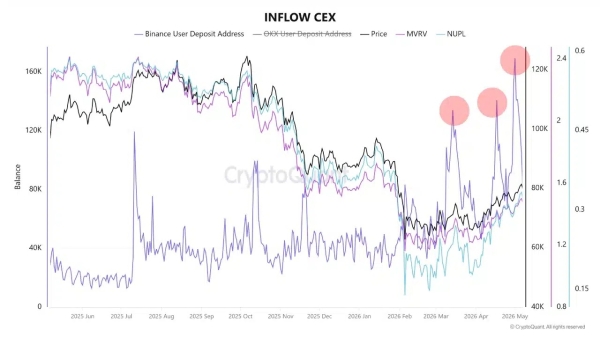 Source: CryptoQuant
The increased institutional confidence in Bitcoin came at a time when the inflows to Binance spiked strongly. As the go-to platform for retail traders from many parts of the globe, it can be concluded that a spike in inflows to Binance implies retail participants were taking profits.
Their preference to stay sidelined as $BTC breached $80k, combined with the steady institutional accumulation since February, presented an interesting contrast.
As always, the parties with more money are assumed to have more influence on the market and access to more information. It is usually less risky to follow smart money than retail.
The argument for an extended local top
On the 4th of May, 14,600 $BTC was sold in a single day. This represented the greatest single-day profit-taking since December 2025, according to XWIN Japan.
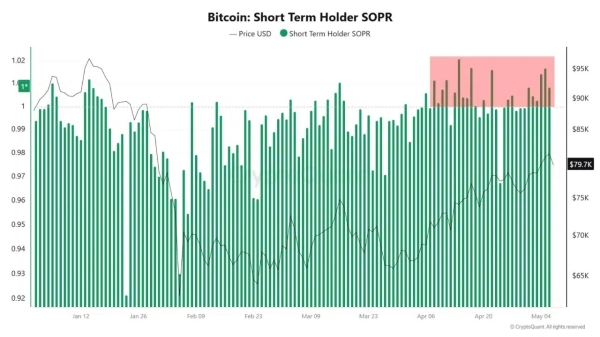 Source: CryptoQuant
The Bitcoin short-term holder SOPR had climbed to 1.016. It has also been above 1 since mid-April, meaning short-term holders have been selling at a profit since then. This metric reinforces the profit-taking idea and the lack of market conviction, likely born from experience with previous bear cycles.
The bounce above $76k improved holder profitability and encouraged sustained selling. This selling has not yet turned into an aggressive distribution from larger long-term holders, leaving the market at a critical inflection point.
The elevated STH SOPR metric can see an extended local top and a bearish correction. Alternatively, it could also be signaling a transition toward a bullish market phase.
Final Summary
- The Bitcoin institutional confidence was rising, while retail continued to sell into strength.
- The short-term holder profit-taking activity was underway, but aggressive $BTC distribution has not yet commenced.