Bitcoin spot ETFs end 13 days of cash outflows
The United States spot Bitcoin (BTC) exchange-traded funds (ETFs) have ended their longest losing streak in 2026.
After recording a net cash outflow of $4.367 billion between May 15 and June 3, the U.S. spot BTC ETFs closed June 4 with a net inflow of approximately $3.05 million, according to data from SoSoValue. As such, the U.S. spot Bitcoin ETFs had $80.40 billion in total assets under management at the time of reporting.
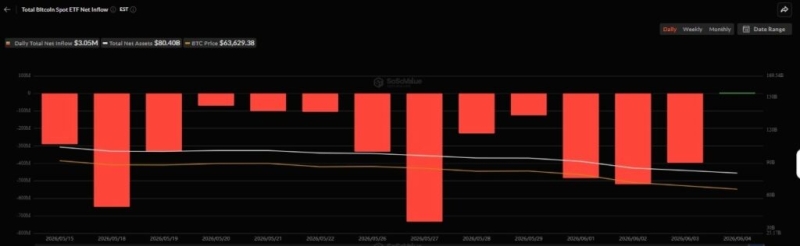
Spot BTC ETFs daily cash flows. Source: SoSoValue
The shift in U.S. spot BTC ETFs was influenced by BlackRock’s iShares Bitcoin Trust (IBIT). After registering a net cash outflow of roughly $47.66 million. As such, BlackRock’s IBIT held around $49.36 billion in total assets.
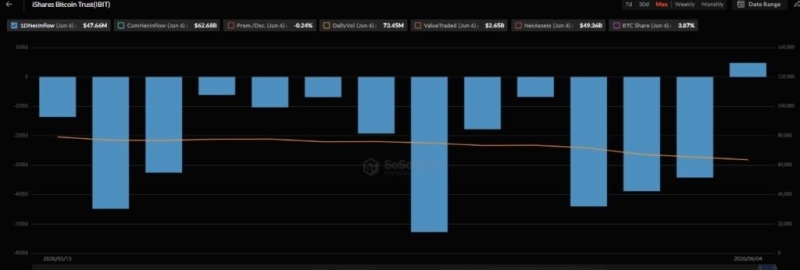
IBIT daily cash flow. Source: SoSoValue
Meanwhile, Fidelity Wise Origin Bitcoin Fund (FBTC) reported a net cash outflow of $5.54 million on Thursday, hence hitting 14 consecutive days of losses. At press time, FBTC held assets worth about $11.46 billion.
XRP News Today: International Finance Bank Confirms XRP As Payment Rail, And Is Income The New Crypto Narrative For 2026?
XRP is back in crypto chatter after an internal presentation by International Finance Bank highlighted its role in financial infrastructure. … Continue reading
Featured Press Release Apr 26, 2026
What’s next for Bitcoin price?
Over the past few years, Bitcoin price has followed the performance of U.S. spot BTC ETFs. For instance, BTC price failed to rally above $82,000 last month, leading to a capitulation to around $60,762 on Friday, as U.S. spot BTC ETFs recorded nearly two consecutive weeks of outflows.
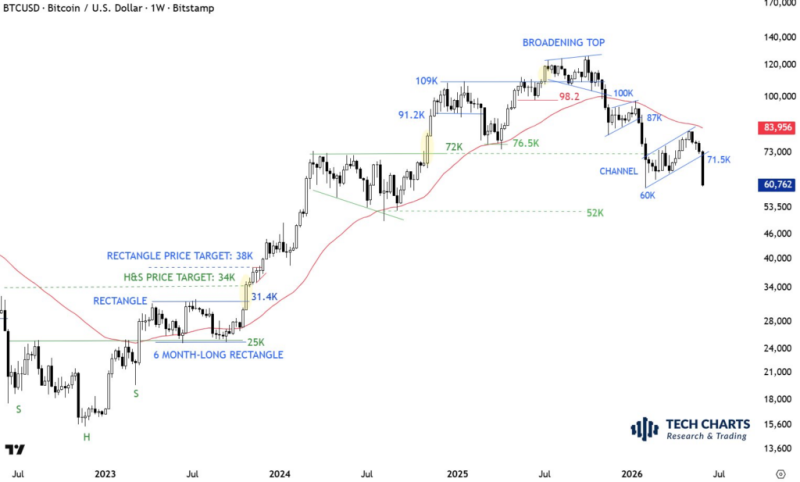
BTC/USD 1-week chart. Source: TradingView
From a technical analysis standpoint, Bitcoin’s price retested its February lows around $60,000 in early June following its capitulation. If U.S. spot BTC ETFs continue to accumulate more Bitcoin, a potential rebound could emerge. However, if BlackRock’s IBIT leads other spot ETF issuers in distribution, a sell-off to $52,000 could be inevitable, as per analysis shared by Aksel Kibar, an ex-fund manager.