Bitcoin loses over 20,000 millionaires since the start of 2026 – Finbold report
Bitcoin loses over 20,000 millionaires since the start of 2026 – Finbold report 
 Cryptocurrency Feb 24, 2026 Share
Over 20,000 Bitcoin (BTC) millionaires have disappeared in less than two months, as the flagship cryptocurrency’s brutal 2026 correction wipes billions from investor portfolios.
A Finbold analysis of current and historic data retrieved from BitInfoCharts and using the Wayback Machine on February 24, 2026, revealed that the number of Bitcoin millionaire addresses fell by 20,564 since January 1, 2026.
Specifically, addresses holding over $1 million in BTC declined by 15.68%, dropping from 131,125 to 110,561. Meanwhile, wallets containing more than $10 million worth of Bitcoin fell by 2,596, from 16,355 to 13,759.
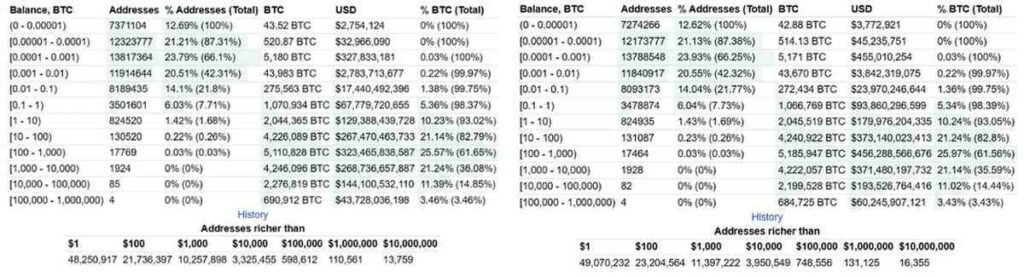 Bitcoin millionaire addresses on February 24 and January 1, 2026. Source: BitInfoCharts & BitInfoCharts via the Wayback Machine
It is important to distinguish between millionaire addresses and individual millionaires. One investor can control multiple wallets, while institutional custodians often divide holdings across several addresses.
A dramatic reversal after 2025’s record rally
The 2026 wipeout extends a downturn that began late last year. After surging to a new all-time high above $125,000 in October 2025 amid a powerful bull market, Bitcoin reversed sharply. By February 24, 2026, BTC had corrected by roughly 50% from its peak.
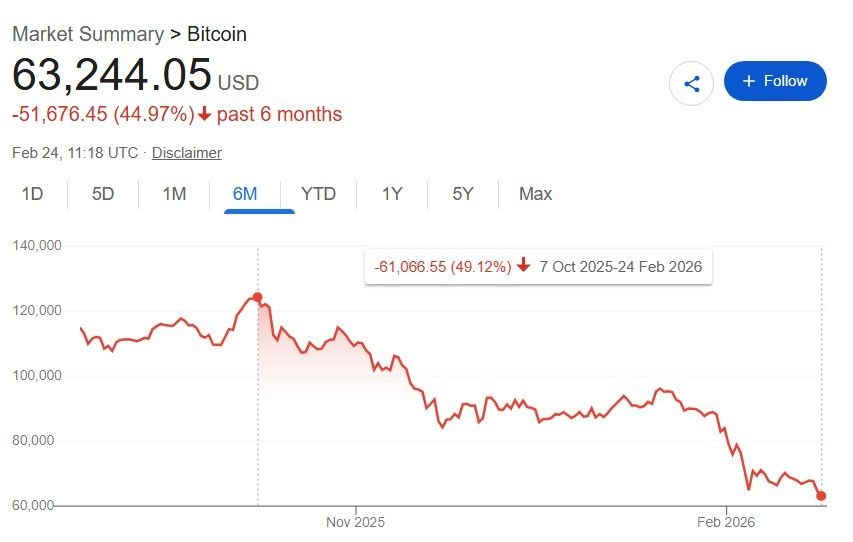 Bitcoin price 6-month chart with trading since early October 2025 marked. Source: Google
Notably, a distinction should be made between Bitcoin millionaires and BTC millionaire addresses, as one person may own multiple addresses and, through various institutional investors, a single wallet might be split between multiple individuals.
Bitcoin wipes $510 billion from its market cap in 2026
Considering the broad cryptocurrency market sell-off of 2026, the decline in the number of BTC millionaire addresses was to be expected. In total, digital assets erased $800 billion from their market capitalization, and Bitcoin alone accounted for $510 billion.
What is somewhat surprising is the circumstances of the crash. The digital assets space has been hoping and calling for institutional acceptance and adoption, regulators taking an amicable stance, and a friendly administration.
By 2025, cryptocurrencies have essentially received all of the desired boons to the point that some of the biggest remaining Bitcoin bulls in 2026 are major, traditional institutions.
Experts and institutions forecast Bitcoin’s 2026 performance
Indeed, while multiple prominent blockchain analysts are estimating that BTC is headed toward cycle lows, Bernstein estimates the bear case is extremely weak and is anticipating a rally to $150,000. Standard Charters was likewise bullish in its downward revisions.
Though the banking giant is no longer anticipating a surge to $150,000, it had, nonetheless, opted for an optimistic $100,000 price target.
Therefore, it remains somewhat unclear if the overall downturn is the result of the traditional cryptocurrency cycle, global instability of the likes unseen, arguably, in decades, or a set of different factors.
Lastly, it is also worth noting that, despite the overall bureaucratic friendliness that marked 2025 and early 2026, the actual, sweeping legal framework for digital assets in the U.S. has both been postponed and is proving contentious.
Featured image via Shutterstock