All about Bitcoin’s bullish market shift and a ‘dangerous’ divergence
At the time of writing, Bitcoin [$BTC] active investors’ mean price was $85K, with the short-term holder cost basis at $78.9K. The cryptocurrency itself was valued at $77.8K, rising after its recent retracement to $74.9K on 29 April.
In a post on X, Glassnode had listed the mean price numbers above, and also that the true market mean was at $78K. This meant that there was a threat of profit-taking from holders as the price inched closer towards $80K once again.
The realized price of the network, which refers to the average cost basis of all Bitcoin holders, was a long way south at $54.1K.
Bitcoin dipped below the realized cost during the previous bear market. And, it might do so this cycle as well.
Short-term $BTC holders are profitable once again
 Source: CryptoQuant
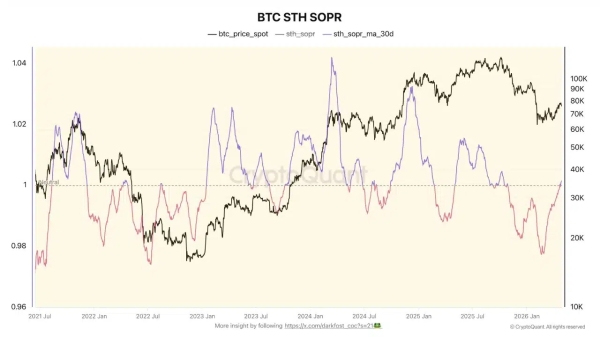
For the first time since October, the 30-day moving average of the short-term holder spent output profit loss (STH SOPR) has turned positive. In other words, Bitcoin’s short-term holders are returning to break-even or a slight profit, on average.
Crypto analyst Darkfost highlighted how the STH SOPR above 1 meant it may be possible the market had reached a turning point. Usually, as the metric approaches profitability, short-term holders sell their holdings and look to exit the market, exhibiting a lack of conviction.
This happened previously in April 2022, marking the end of a dead cat bounce from $36K to $47K.
It is possible that a similar scenario would unfold once again, though the market has remained calm and an aggressive sell-off has not yet begun.
The “dangerous” Bitcoin divergence
 Source: CryptoQuant
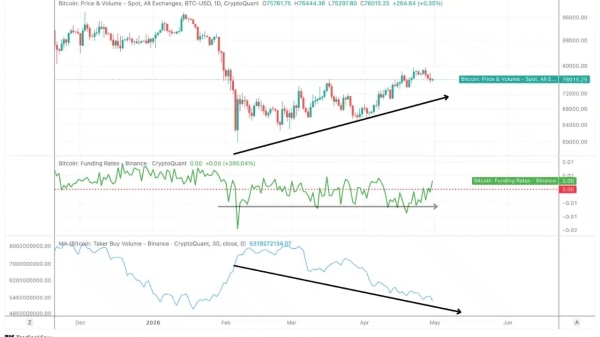
Analyst Moreno DV pointed to the divergence between the price, funding rates, and taker buy volume. While the price has set higher lows since February, the funding rate has remained largely flat.
The most compelling part seemed to be the falling taker buy volume. Since it is the takers, or the aggressive market buyers/sellers, who move prices, a downtrend in taker buy volume indicates fewer market participants chasing Bitcoin’s price move higher.
This meant that the market could be undergoing a phase of accumulation, with large market players absorbing the supply through limit orders.
Alternatively, the falling taker buy volume meant that the rally reflected an absence of strong sellers, not the presence of large buyers, making the move fragile.
Final Summary
- Bitcoin’s rally faces a handful of cost basis obstacles from $78K to $85K, giving holders an incentive to sell.
- Rallies driven by a lack of sellers instead of the presence of sustained, aggressive buyers are structurally weaker.