Clarity Act markup leaves bitcoin unstirred
This is an excerpt from CoinDesk newsletter ‘Daybook.’ Sign up here, if you haven’t already.
The week’s main event for digital assets, the U.S. Clarity Act markup, is due later today. The crypto market, led by bitcoin, seems to be treating it as a non-event.
The proposed bill aims to establish a comprehensive regulatory framework for digital assets. The latest draft, released on May 11, includes several key provisions, including a ban on interest on stablecoin balances and a $5 million penalty for violations. It also adds the Treasury as a rule-making authority alongside the SEC and CFTC.
There is still no ethics language preventing government officials from issuing tokens, though observers expect it may be introduced during markup, when a Congressional committee will review, debate and amend the wording line by line.
“As the framework moves toward passage, $BTC‘s case as a strategic allocation with unique diversification benefits in a balanced portfolio only strengthens,” said Can-Luca Köymen, an investment strategist at Sygnum Bank.
Not everyone is happy with the current wording.
Over 100 Substack amendments were submitted ahead of a Wednesday deadline, including one proposing a ban on Federal Reserve master accounts for crypto companies.
“That could be problematic,” said Noelle Acheson, author of Crypto is Macro Now, in her latest note. She added that while progress is positive, “there is still much that could go wrong tomorrow.”
She noted that to secure passage in the Senate, the committee will need bipartisan support. Without it, she warned, the chance of the bill passing this year, about 60% on Polymarket, could fall sharply.
Despite the high stakes, $BTC implied, or expected, volatility metrics remain subdued, pointing to steadier market conditions.
“Volatility expectations [in $BTC] are compressed at all forward horizons, with short-dated options trading close to their year-to-date lows (with implied volatility at a historical low of 30%),” said Andrew Melville and Thahbib Rahman of Block Scholes. “There’s also no obvious event risk priced-in by either $BTC or altcoin options ahead of the Senate CLARITY Act markup.”
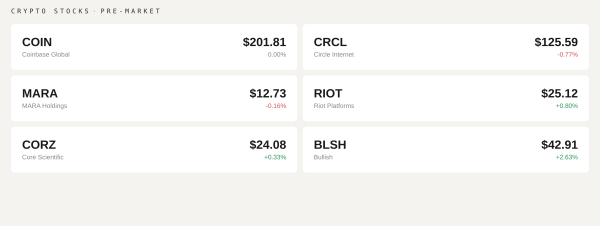
There are, however, signs of stress in markets tied to Coinbase (COIN). “[There] we do see an embedded implied vol premium in the May-15 contract which covers the debate date, suggesting traders are clearly pricing for the bill to act as a catalyst for companies that stand to benefit from regulatory clarity, but not for $BTC,” they said. Stay alert!
Read more: For analysis of today’s activity in altcoins and derivatives, see Crypto Markets Today . For a comprehensive list of events this week, see CoinDesk’s “Crypto Week Ahead.”
What’s trending
- Solana drops 5%, bitcoin below $80,000 as Xi warns Trump on Taiwan conflict (CoinDesk): Chinese President Xi Jinping pressed his U.S. counterpart Donald Trump on Taiwan in their first meeting. He warned Trump that mishandling the issue could lead to conflict and push bilateral ties “into a highly perilous situation.”
- Xi tells U.S. CEOs accompanying Trump that China will open up more (Bloomberg): Xi Jinping signaled China is moving toward greater openness, striking an upbeat note during his meeting with U.S. business leaders accompanying Trump, following a more divisive meeting between the two leaders on the topics of trade and Taiwan.
- Record high for stocks as Trump meets Xi, pound braces for UK leadership fight (Reuters) – AI leads world stocks to third straight record high on Thursday, while the U.S. dollar stands tall on rate-hike wagers.
- Moody’s awards top rating to Fidelity and BlackRock’s tokenized money market funds (CoinDesk): Moody’s assigned its highest credit rating to tokenized money market funds from Fidelity and BlackRock. The AAA-mf rating signals an extremely strong ability to ensure high liquidity and capital preservation and the lowest level of risk.
Today’s signal
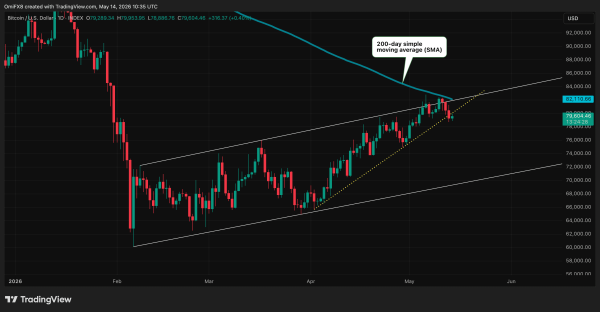
Bitcoin backed away from the confluence of the 200-day simple moving average and the upper boundary of the rising channel that has defined the recovery from February lows.
It’s not just a routine pullback from resistance.
The decline has now also pierced the short-term upward (dotted) trendline drawn from April’s lows, suggesting that the latest leg of the recovery has ended.
Taken together, these signals increase the risk of momentum-driven selling entering the market, potentially driving prices down to $75,000 or lower. On the higher side, the 200-day average placed just above $82,000 is the level to beat to revive the bullish outlook.