Crypto markets set odds of U.S. recession in 2026
Crypto markets set odds of U.S. recession in 2026 
 Cryptocurrency Mar 30, 2026 Share
Cryptocurrency-powered prediction markets on Polymarket have seen a rise in the odds of a U.S. recession in 2026 as the economic outlook remains uncertain.
In this line, markets currently price the probability at 37%, with traders buying “Yes” shares at $0.37, implying a 63% chance the economy avoids a downturn through December 31, 2026, according to data retrieved by Finbold on March 30.
The contract has attracted nearly $916,000 in trading volume and will resolve on January 31, 2027, based on either an official recession declaration by the National Bureau of Economic Research or two consecutive quarters of negative GDP growth.
The implied probability was in the low-to-mid 20% range in late February before jumping about 15 percentage points in early to mid-March, briefly exceeding 45%.
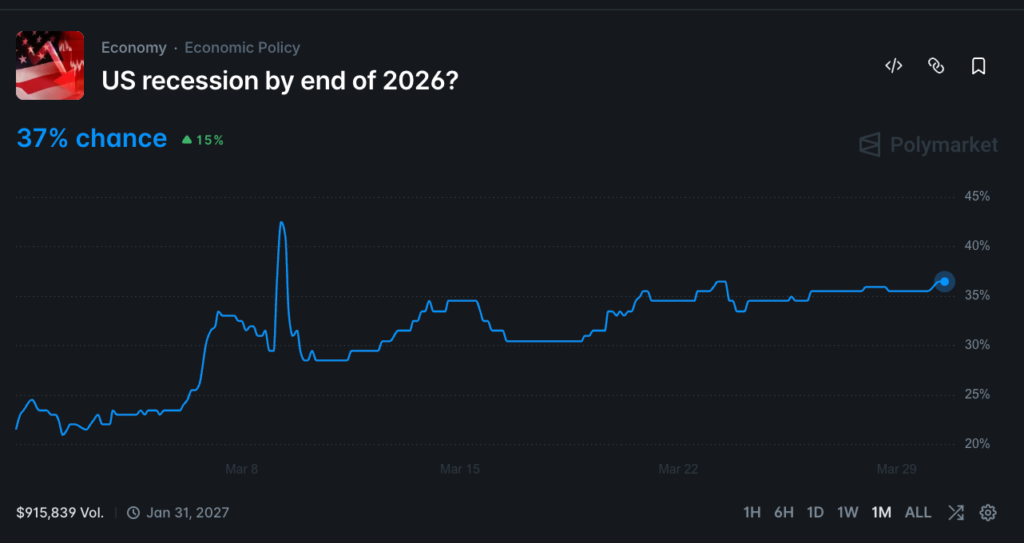 U.S. recession odds. Source: Polymarket
Geopolitical tensions trigger recession concerns
The increase coincided with escalating geopolitical tensions involving Iran, which pushed oil prices above $100 per barrel and raised concerns about supply disruptions through the Strait of Hormuz.
After peaking, recession odds eased and have stabilized around 36% to 37%, with a slight uptick in late March.
These odds come as the labor market remains stable. Specifically, unemployment held at 4.4% in February 2026, with weekly jobless claims near cycle lows of about 210,000.
Fourth-quarter 2025 GDP grew at a 1.4% annualized pace, though momentum has slowed, with some data pointing to softer recent readings.
Following its March 18 meeting, the Federal Reserve kept interest rates at 3.5% to 3.75% and signaled one additional 25-basis-point cut this year, while projecting GDP growth of around 2%.
At the same time, Wall Street firms have raised recession risks in response to higher energy costs and slowing growth.
For instance, Goldman Sachs lifted its 12-month recession probability to 30%, citing elevated oil prices that pushed its PCE inflation forecast to 3.1% and lowered GDP growth expectations to 2.1%.
On the other hand, Moody’s Analytics placed the odds at 48.6%, warning that sustained energy pressures could push the risk toward or above 50%. EY-Parthenon estimated a 40% probability, while Wilmington Trust put it at 45%, both highlighting risks to consumer spending and business investment.
Attention is now turning to upcoming data releases, including April’s employment report for March and the advance estimate of first-quarter 2026 GDP, which could prompt further repricing if job growth weakens or energy-driven inflation persists.