Ethereum leverage surges to 75% on Binance; Here’s what it means
Ethereum leverage surges to 75% on Binance; Here’s what it means 
 Cryptocurrency Mar 20, 2026 Share
Leveraged positions in Ethereum (ETH) on Binance have climbed to a new all-time high, with more than 75% of positions now using leverage.
As of March 20, data from CryptoQuant shows that Binance’s Estimated Leverage Ratio (ELR), which measures the ratio between open interest and exchange-held reserves, has reached elevated levels. In practical terms, this means that for every 1 ETH held on the exchange, traders have built positions equivalent to roughly 3 ETH through leverage.
With a large share of exposure now concentrated in derivatives rather than spot holdings, price action becomes increasingly sensitive to changes in positioning, funding, and liquidation flows rather than underlying demand.
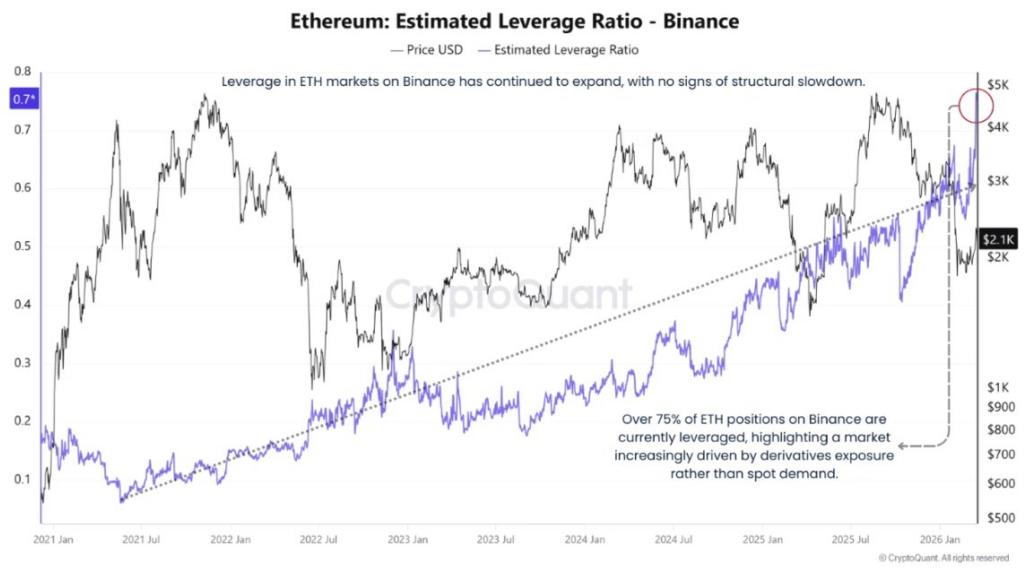 ETH estimated leverage ratio on Binance. Source: CryptoQuant
ETH leverage-driven structure raises volatility risk
The increase in leveraged positioning suggests that Ethereum’s recent upside is being supported by derivatives flows. While this can sustain price expansion in the short term, it also introduces structural fragility.
In highly leveraged environments, relatively small price moves can trigger cascading liquidations. If ETH fails to maintain upward momentum, long liquidations could accelerate downside, particularly given the imbalance between open interest and available spot liquidity on the exchange.
Ethereum price gains on extreme leverage
Ethereum has gained more than 9% in March, trading at approximately $2,146 at the time of writing. The move aligns with rising leverage on Binance, which remains the dominant venue for derivatives trading.
However, broader participation appears to be weakening. Ethereum’s 24-hour trading volume across all exchanges has declined by 16.6% to around $22.12 billion, as per data from CoinMarketCap.
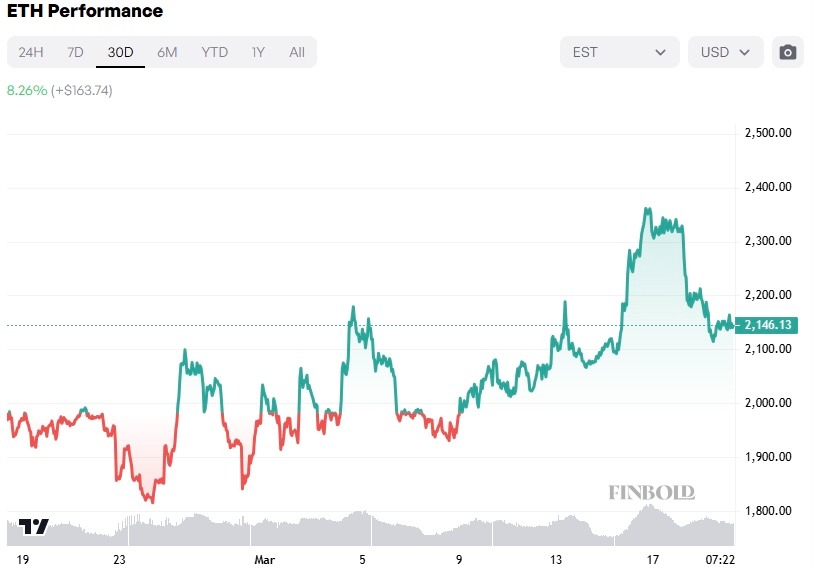 ETH price performance 30D. Source: Finbold
The divergence between rising price and declining volume reinforces the view that the current move is being driven by leveraged positioning rather than sustained spot demand. Under these conditions, price stability becomes increasingly dependent on the continuation of leveraged flows.