Bitcoin’s early crash to $60,000 now looks like a warning for stocks
Many see bitcoin $BTC$71,329.00 as a safe-haven and store-of-value asset, like gold. But some currency traders treat it as a lead indicator for broader market mood, and they’ve been proven right again: Before finding stability near $70,000 recently, bitcoin plunged sharply, presaging the ongoing global stock market swoon.
Bitcoin’s price peaked above $126,000 in early October and started falling, eventually hitting lows near $60,000 early last month. The sell-off featured rapid outflows from U.S.-listed spot ETFs. CoinDesk flagged this in January, questioning whether these flows – absent any clear crypto trigger – signaled an incoming macro economic blowup and stock market sell-off.
Fast forward to today: Global market sentiment has worsened, with the Iran war and oil price spike weighing heavily on Asian and European indices. The S&P 500 and Nasdaq have also come under pressure while the dollar index gains. Meanwhile, bitcoin has been rock steady around $70,000.
Here’s where it gets even more interesting: Key stock indices like the S&P 500 mirrored Bitcoin’s pre-crash back-and-forth trading in a broad range.
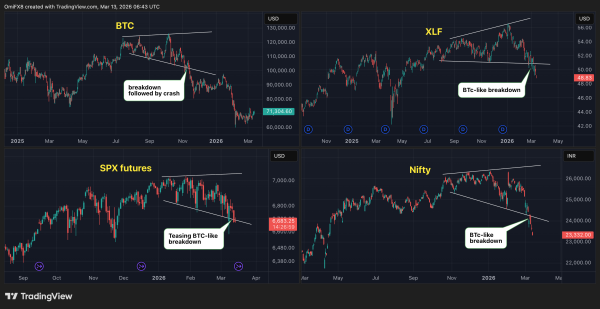 Daily charts for $BTC, SPX futures, XLF and Nifty. (TradingView)
Bitcoin held above $100,000 for months in this volatile, expanding channel before plunging into bear territory. An identical setup has unfolded in the SPDR Financial Select Sector ETF (XLF), India’s Nifty (among the hardest hit), and S&P 500 futures.
Repeat of 2021-22
This isn’t the first time bitcoin has led price action in traditional risk assets. Over the years, the cryptocurrency has often foreshadowed equity trends, most clearly in late 2021-2022.
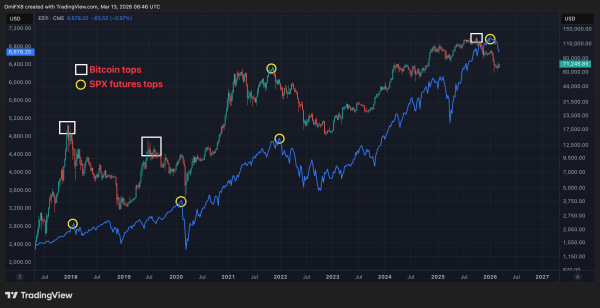 $BTC versus S&P 500 e-mini futures. (TradingView)
$BTC peaked near $60,000 in November 2021 and quickly tanked to under $50,000 in a month. The bear market deepened in 2022. The Nasdaq and S&P 500 topped out two months later in January 2022, then followed suit with their own prolonged declines as the Federal Reserve raised borrowing costs rapidly.
Todd Stankiewicz, president and chief investment officer of SYKON Capital, in a blog post on the Chartered Market Technicial (CMT) Association website, noted bitcoin’s tendency to peak before the S&P 500 in three key instances: late 2017, weeks before the COVID crash, and late 2021.
“Bitcoin either rolled over or failed to make new highs while the S&P 500 pushed ahead. In each case, the equity rally eventually stalled and reversed,” Stankiewicz said.
All things considered, the takeaway is clear: Stock traders should start watching bitcoin trends closely from here.