Top economist explains why Bitcoin will hit $120,000 in March 2026
Top economist explains why Bitcoin will hit $120,000 in March 2026 
 Cryptocurrency Mar 1, 2026 Share
Macro economist Henrik Zeberg has outlined a compelling case for Bitcoin (BTC) surging to between $110,000 and $120,000 this month.
Zeberg attributed this anticipated rally to a combination of heightened risk appetite across financial markets, substantial inflows into exchange-traded funds (ETFs) focused on digital assets, and growing adoption by major institutions seeking exposure to cryptocurrencies.
In an X post on March 1, Zeberg noted that his primary outlook positions Bitcoin at a cycle peak within the $110,000 to $120,000 range, representing significant upside from its current levels. Indeed, the target implies a possible 80% increase from Bitcoin’s press-time value of $66,052.
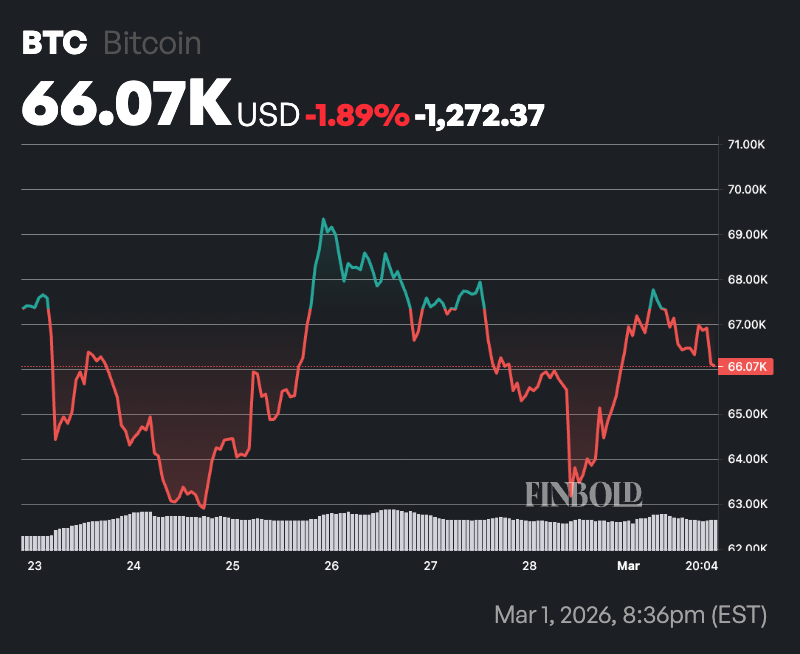 Bitcoin seven-day price chart. Source: Finbold
Zeberg also considered a less likely but possible extension of the rally, assigning a 25% probability to Bitcoin overshooting to between $140,000 and $150,000 if market momentum intensifies beyond expectations.
“Bitcoin rallies to $110–120K in the primary scenario – fueled by Risk-On Fever, ETF inflows, and continued institutional adoption. There is a secondary scenario at $140–150K (25% probability) should momentum overshoot into a more extended cycle top,” he said.
His framework emphasizes the role of broader economic conditions in fostering a risk-on environment, where investors shift toward high-growth assets like cryptocurrencies amid favorable liquidity and policy signals.
Crypto market outlook
Beyond Bitcoin, the economist extended his analysis to other major digital assets, projecting Ethereum (ETH) to reach between $10,000 and $12,000 as its ratio to Bitcoin converges around 10%, reflecting improved relative performance driven by similar institutional interest and network upgrades.
On the other hand, Solana (SOL), positioned as a high-beta play within the ecosystem, could climb to between $350 and $500, benefiting from amplified volatility and adoption in decentralized applications.
Recent market developments provide context for Zeberg’s optimistic view, with Bitcoin currently trading around $70,000 following a sharp correction from its 2025 high of over $126,000.
Analysts note that this pullback, nearing 50%, aligns with historical patterns but may be mitigated by institutional involvement through ETFs, which have cushioned declines compared to past cycles.
Indeed, this outlook comes at a time when Bitcoin has faced increased volatility, including a sharp dip toward $60,000 amid geopolitical tensions involving U.S. and Israeli strikes on Iran, before rebounding to as high as $68,000.
The cryptocurrency has been under pressure since its 2025 high above $126,000, entering what many describe as a bearish consolidation phase.
Featured image via Shutterstock